Almost everyone learning Portuguese knows the pattern: you download an app, work through lesson 1, 2, 3 — and a few weeks in, you realize that while you can recite "a maçã" (the apple) from memory, you still can't understand what the waiter just asked you at the café. The problem is rarely discipline. It's how vocabulary gets learned in the first place.
Topics you actually care about make the difference
Memorizing vocabulary from a generic frequency list — the 1,000 most common words, regardless of your own life — feels like studying for a test that never happens. The words rarely stick, because they don't attach to anything.
It's different when the vocabulary comes from a topic you're genuinely interested in: your move to Portugal, your own hobby, a current event you're actually following. Reading or listening to things that genuinely interest you means you pick up exactly the words that show up in your own everyday life — not the ones a textbook prescribes for everyone equally.
The right level is just as hard to find
Even once you've found a topic you care about, there's a second problem: finding a text or podcast that actually matches your level. Native content is often too fast or too advanced; graded readers made for learners can feel oversimplified and disconnected from anything you'd actually want to read about. So you either give up on the topic, or you push through material that's too hard and end up looking up nearly every second word — which kills motivation just as fast as boredom does.
The real problem: handling the vocabulary
Even with the right topic and the right level, things often fall apart at something much more mundane: the handling.
You're reading an article or listening to a podcast in Portuguese. Every few sentences, an unfamiliar word shows up. So: pause. Look the word up. Find the translation. Write it down somewhere — on a piece of paper, in a notes app, maybe in a separate vocabulary app that has nothing to do with the original text. Keep reading. Next unfamiliar word, same process all over again.
And then, once you've finally collected a list of twenty or thirty words: how do you actually learn them? Write flashcards by hand? Maintain a spreadsheet? Go find yet another app just for reviewing? Most people give up right at this point — not because they're lazy, but because the path from "I'm reading something interesting" to "I have a working study routine" has too many breaks in it.
How Vocatua solves this
This exact chain — topic, level, looking up, capturing, reviewing — is why Vocatua is built the way it is:
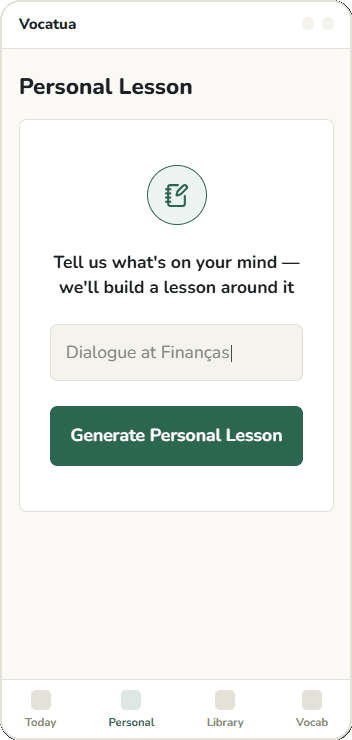
- Personalized lessons instead of a fixed curriculum. You simply enter the topic you're currently interested in and get a text on it, at your own level. The vocabulary is automatically your own, not that of an anonymous frequency list.
- A library of texts across levels, matched to you. Instead of hunting for native content that happens to fit your level, Vocatua generates texts calibrated to where you are — and suggests the ones that fit, so you're never stuck choosing between "too easy" and "way over my head."
- Capture vocabulary directly while reading. An unfamiliar word gets flagged right where it appears — translation and the sentence it came from included. No switching to another app, no scrap of paper, no looking things up somewhere else. The break between reading and capturing simply disappears.
- Regular reminders instead of self-organization. Captured words automatically land in a flashcard mode. You don't have to figure out yourself when and how to review — the system reminds you and prioritizes whatever needs the most practice.
The result: "I'm reading something interesting in Portuguese, at a level that actually fits me" turns directly into a learning routine, without you having to build a vocabulary system around it yourself.